Know your story.Know the room.Know your craft.

Start free

Free covers your experience interview and 3 tailored CVs a month.

Example application

Tell me about a roadmap item you killed, and why.

Asha Verma · Chief Product Officer · round 2

Seller tiering

We killed the seller-tiering proposal. The pricing test showed our biggest sellers would not change behaviour, so we’d have spent a quarter of build time for nothing.

  • From your own interview

    a quarter of build time confirmed by you, in your words

  • From research on Asha

    “The roadmap is the list of things we said no to.”

    Conference talk, Mar 2026 · moderate

  • From the best writing on prioritising

    Rule: Kill it when your biggest customers will not move.

Next Story prepares you for each interview at a UK tech company from your own experience, research on the people you’ll meet, and the best writing in your field. It starts by interviewing you, because your strongest answers are already in your work. Then it stays with you: each application gets its own conversation, at every stage from the advert to the offer.

Most interviews aren’t lost on research.

Next Story is built on data from more than 150 applications and interview processes.

More preparation rarely closes the gap. A research pack that runs to hundreds of pages doesn’t help in the room.

What costs rounds is simpler: a story ready for the exact thing the interviewer cares about, left untold. An answer with no numbers in it. The right material is there. It just isn’t to hand when the question lands.

So Next Story is built for that moment: fewer, better stories, matched to the person asking, on one page you can read in the hour before the call.

A top role is worth real effort, and the effort that counts most comes first. Next Story interviews you about your work until your best stories are on record, in your words and with the numbers behind them. Everything after is built on that.

How it works.

Landing a top role takes real work, and the most important part comes first: Next Story interviews you. What you confirm becomes your record, and every application and every interview draws on it.

Time spent there pays off in every round after. And it doesn’t end there: each application has its own chat, there at every stage from the advert to the offer.

Let Next Story interview you

Once, to start

  • Upload your CV and add your LinkedIn profile.

  • Next Story interviews you about your work, in 30 questions at most, and draws out your core stories, the impact behind them and the numbers.

  • You confirm each fact in your own words. Nothing unconfirmed is ever used.

This is the step that makes everything else work. Give it the time it deserves.
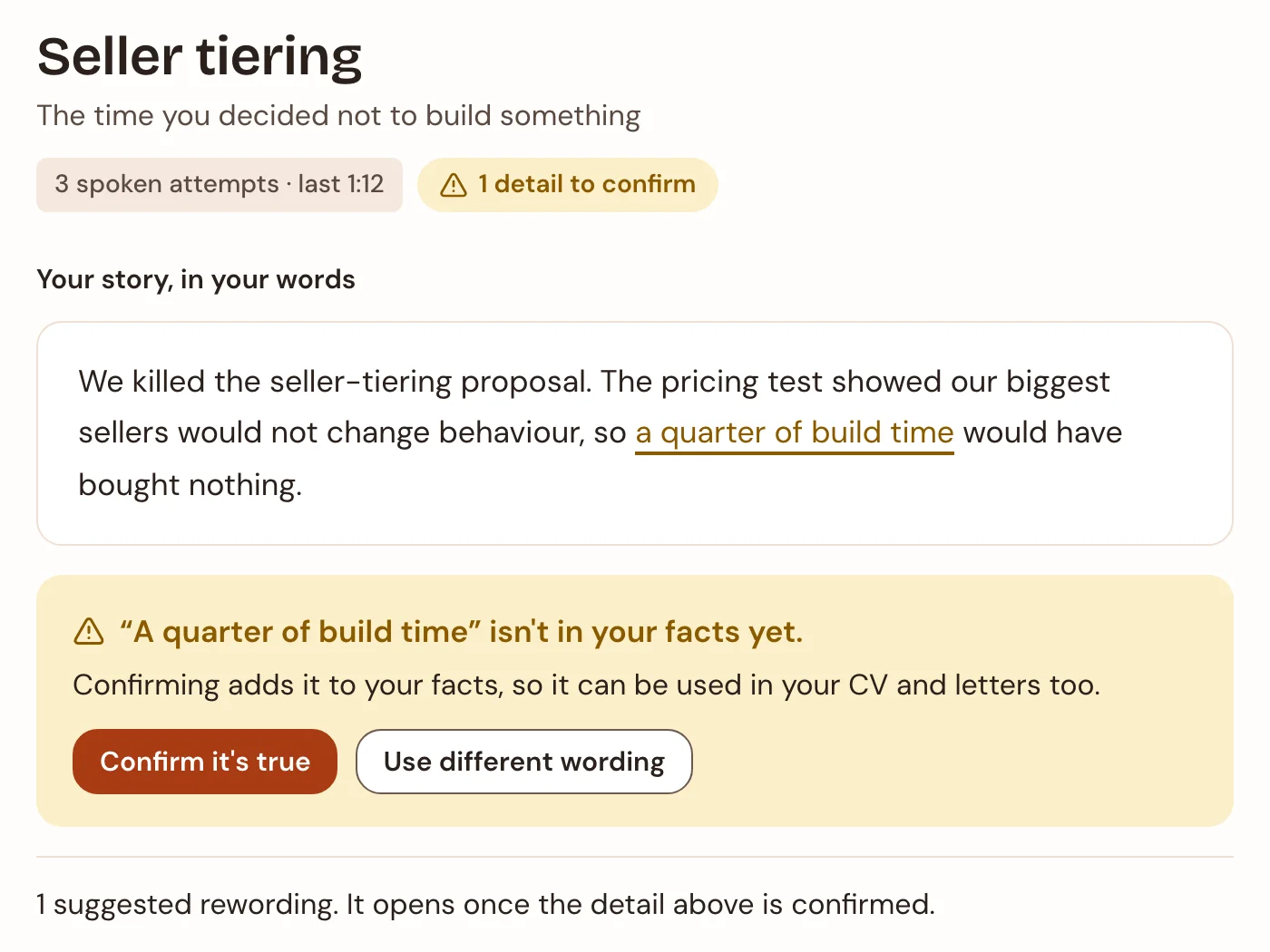
The story Seller tiering in the candidate's own words, with “a quarter of build time” waiting to be confirmed before it can be used.

A number drawn out of your story, waiting for you to confirm it. Example application. Company and people invented.
Apply with a CV that fits

For each application

  • Paste the job advert.

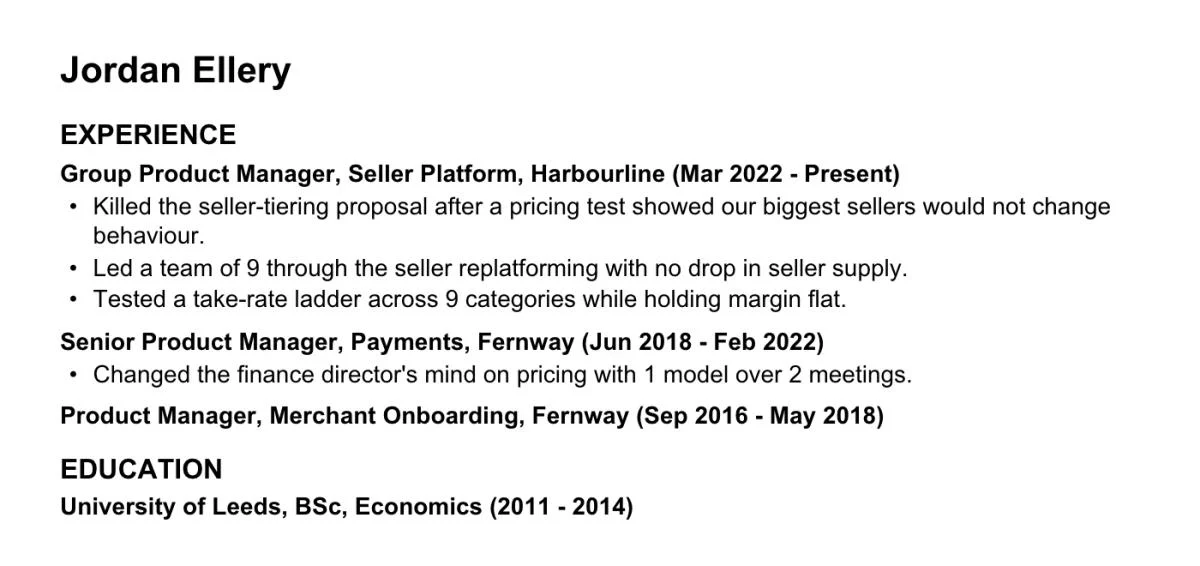
  • Get a CV and cover letter tailored to it, built only from your confirmed facts.

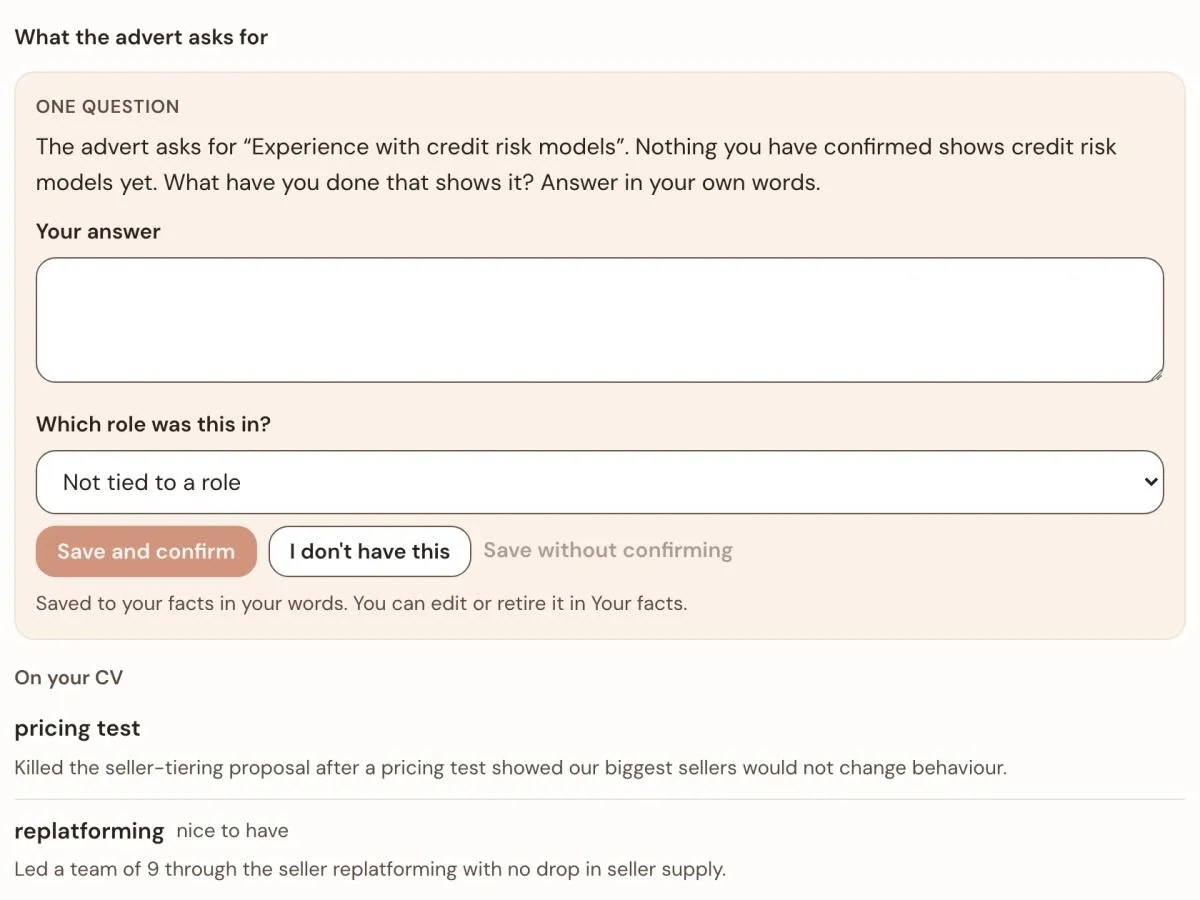
  • Where the advert asks for something your record doesn’t show, you’re asked one question to fill the gap.

The advert asks for experience with credit risk models; Next Story asks one question to fill the gap, above the CV lines it already has.
A tailored CV for Jordan Ellery, built only from confirmed facts.

What the advert asks for, and the CV built only from facts you confirmed. Example application. Company and people invented.
Prepare with Next Story

When you get an interview

  • It researches the company and the people interviewing you.

  • Together you pick and rehearse the stories each interviewer will care about.

  • You get a one-page card for the day, and a debrief afterwards that sharpens the next round.

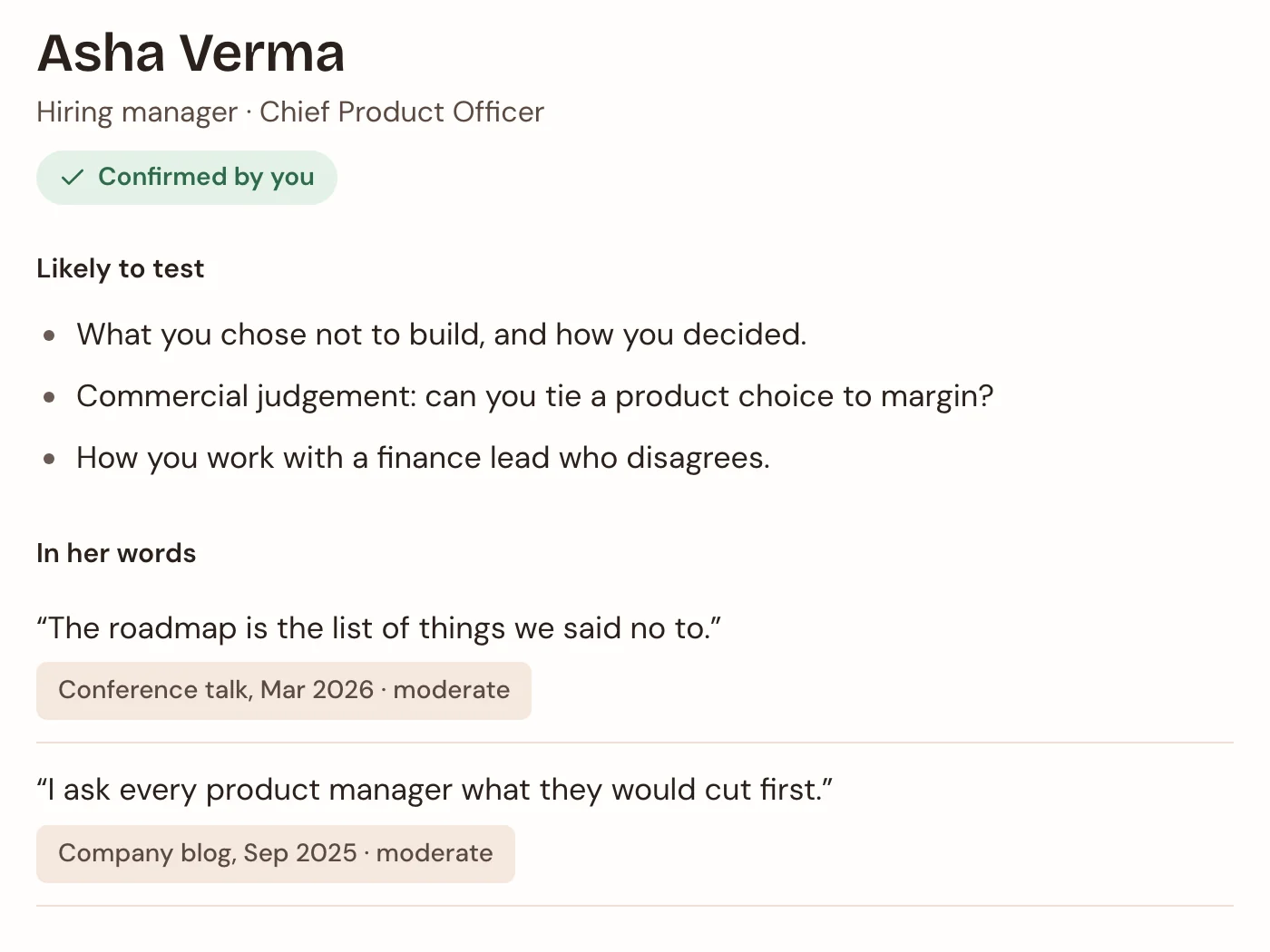
Asha Verma, Chief Product Officer: what she is likely to test and two things she has said in public, with their sources.

What your interviewer is likely to test, in their own words. Example application. Company and people invented.

A conversation at every stage, from advert to offer.

Each application has its own chat, there at every stage. It knows the role, your confirmed facts and the documents for that application, and it keeps the whole conversation, so you pick up where you left off. It only ever works from what you’ve confirmed.

At any stage you can paste a link to a page about the company or the person you’re meeting, or attach a screenshot, and it reads it before it answers. Full company research is a separate document in your pack.

  1. Before you apply

    Ask whether the role fits your record, and what you’d lead with. It reads the job post saved on the application.

  2. Applying

    Ask for a change to your CV or cover letter, or to an answer for a form question. The new version waits in your pack until you choose Keep or Revert.

  3. Each interview round

    Ask what someone in your interviewer’s role is likely to test, drawing on the company research in your pack.

    Practise an answer with it playing the interviewer, in writing, and hear what landed and what to say earlier.

  4. After each round

    Tell it how it went, and work out what to change for the next one.

  5. At the offer

    Think it through: what you were hoping for, what you’ve been offered, and what to ask before you answer.

The Northbank application's chat. Next Story plays Asha Verma, asks “Tell me about a roadmap item you killed, and why”, then gives feedback on the answer.

Each interview round: a practice question in the application’s chat, and the feedback on the answer. Example application. Company and people invented.
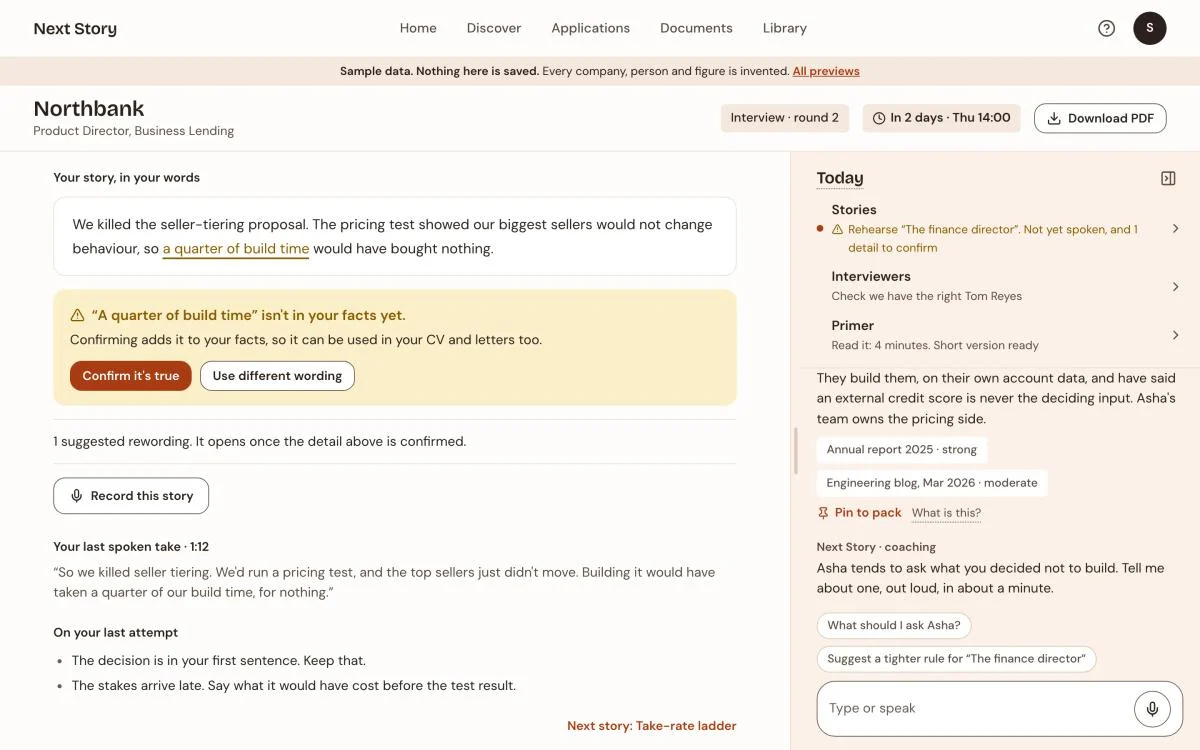
Know your story.

It starts with an interview about you.

Next Story asks about your work the way a good interviewer would, and keeps what you confirm in your own words. When a job advert asks for something it doesn’t know about you yet, it asks.

From those answers you build a few core stories for each round. Each one says which questions it answers, carries one number, and keeps the lines you want to say the same way every time. Anything you haven’t confirmed is marked, so you know what you can stand behind.

The story Seller tiering in the candidate's own words, with one detail still to confirm, their last spoken take and feedback on that attempt.

Your words, with any detail still to confirm marked · Your last spoken take, and what landed and what to say earlier

A story in your words, with feedback on your last take. Example application. Company and people invented.
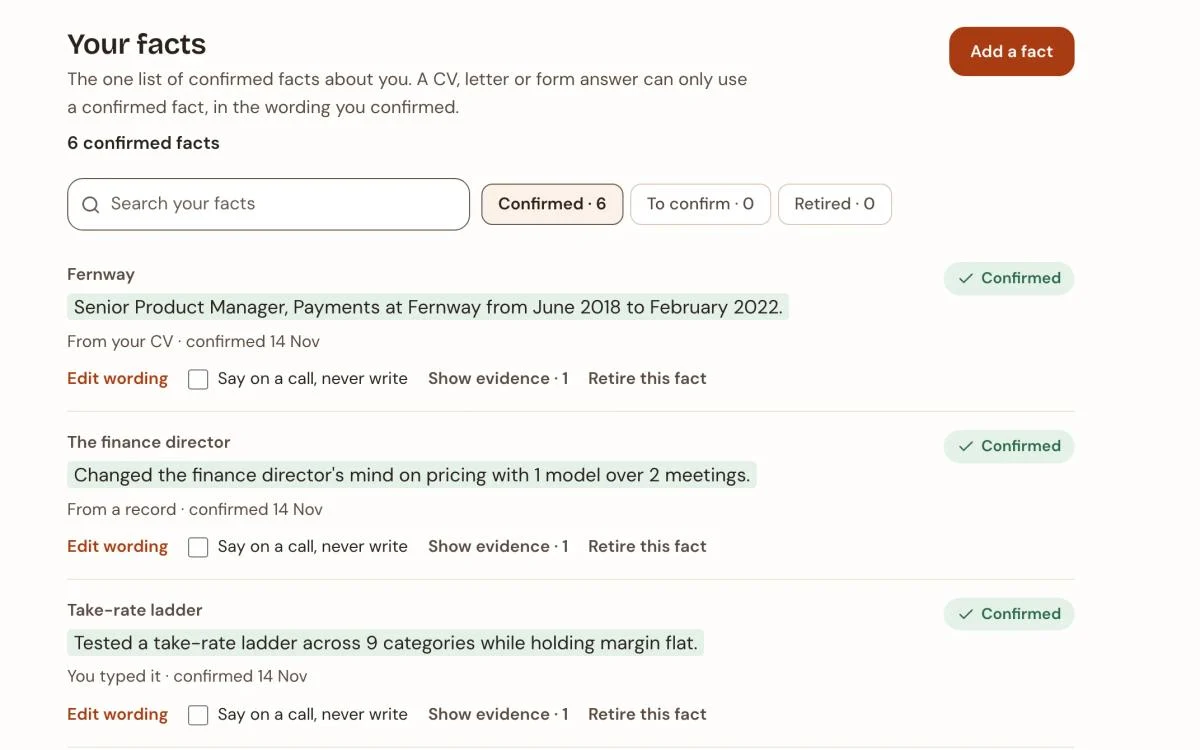
The candidate's confirmed facts, each marked with where it came from: their CV, a record, or words they typed.

Your own words, approved by you · Where each fact came from

The facts you've confirmed, each with where it came from. Example application. Company and people invented.
Know the room.

Research on the company, and on the people across the table.

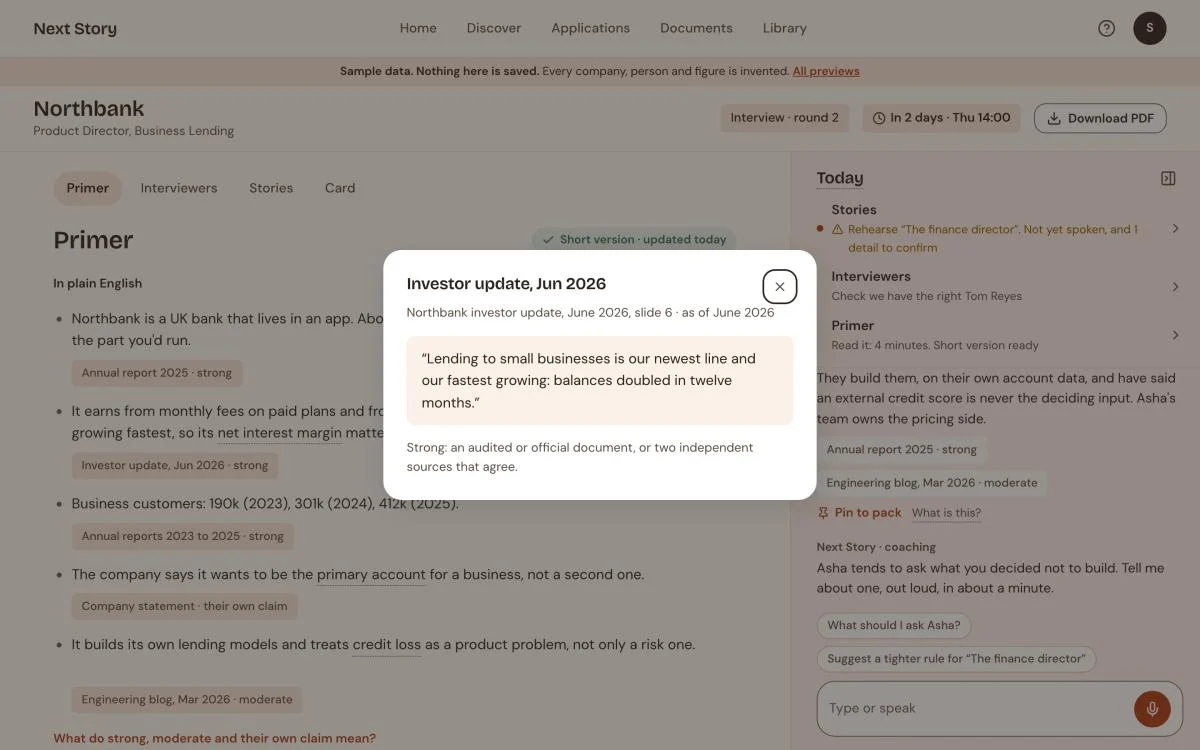
For each interview you get a short primer in plain English: what the company does, how it makes money, what’s changed recently, and the terms you’ll hear. Every claim shows its source, how strong that source is, and when it dates from. What the company says about itself is labelled as such.

You choose how deep to go for each interview: quick, standard or deep.

For each person you’ll meet, you confirm who they are first. Then you see what they’re likely to test, what they’ve said in public with links to where they said it, and how to tune each of your stories for them.

The company primer with one source opened: a quoted passage from an investor update, its date, and why it counts as a strong source.

Plain English, terms defined · Every claim shows its source, strength and date · What the company says about itself is labelled

The primer, with a source opened. Example application. Company and people invented.
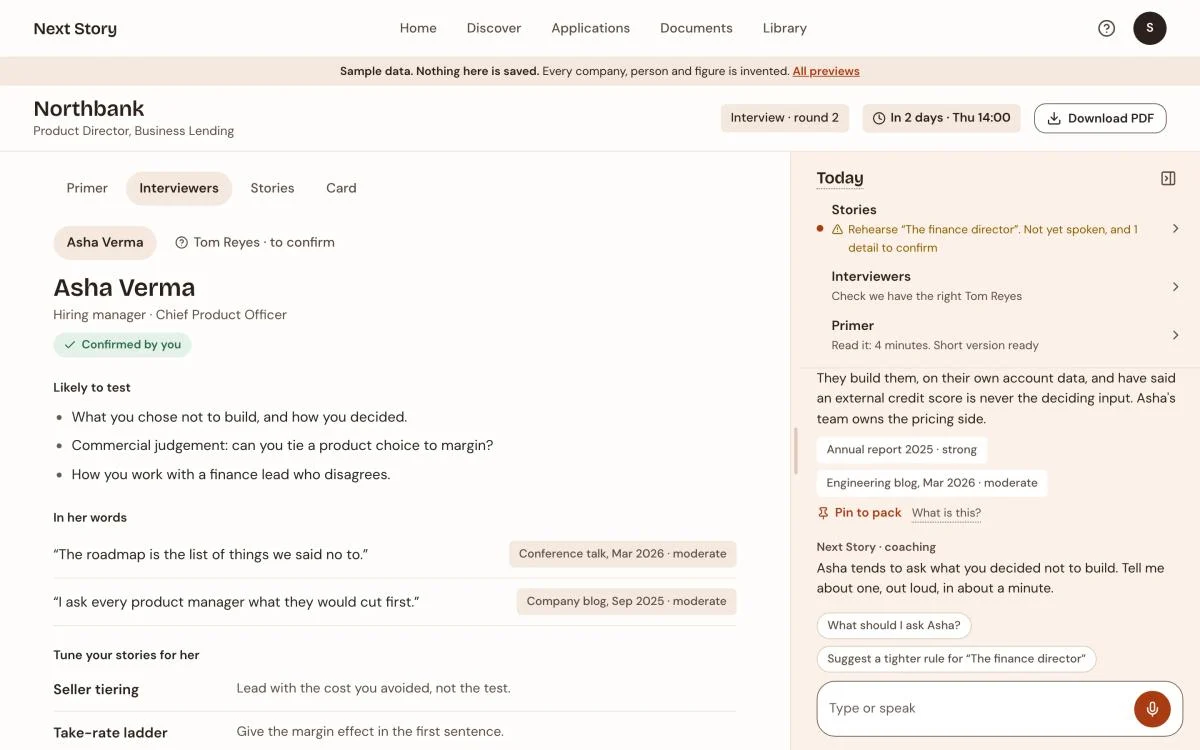
The interviewer view for Asha Verma: what she is likely to test, her own published words with their sources, and how to tune two stories for her.

What they're likely to test · Their own words, with where they said them · How to tune each of your stories for them

An interviewer view. Example application. Company and people invented.
Know your craft.

What the best in your role would say.

Next Story keeps a short kit of ideas from respected writing in your field: rules for prioritising, handling conflict, choosing metrics. Each one is a short quote, attributed and linked.

For each kind of question you’re likely to get, it offers at most two. You pick one and put it in your own words, and it becomes the rule beside your story.

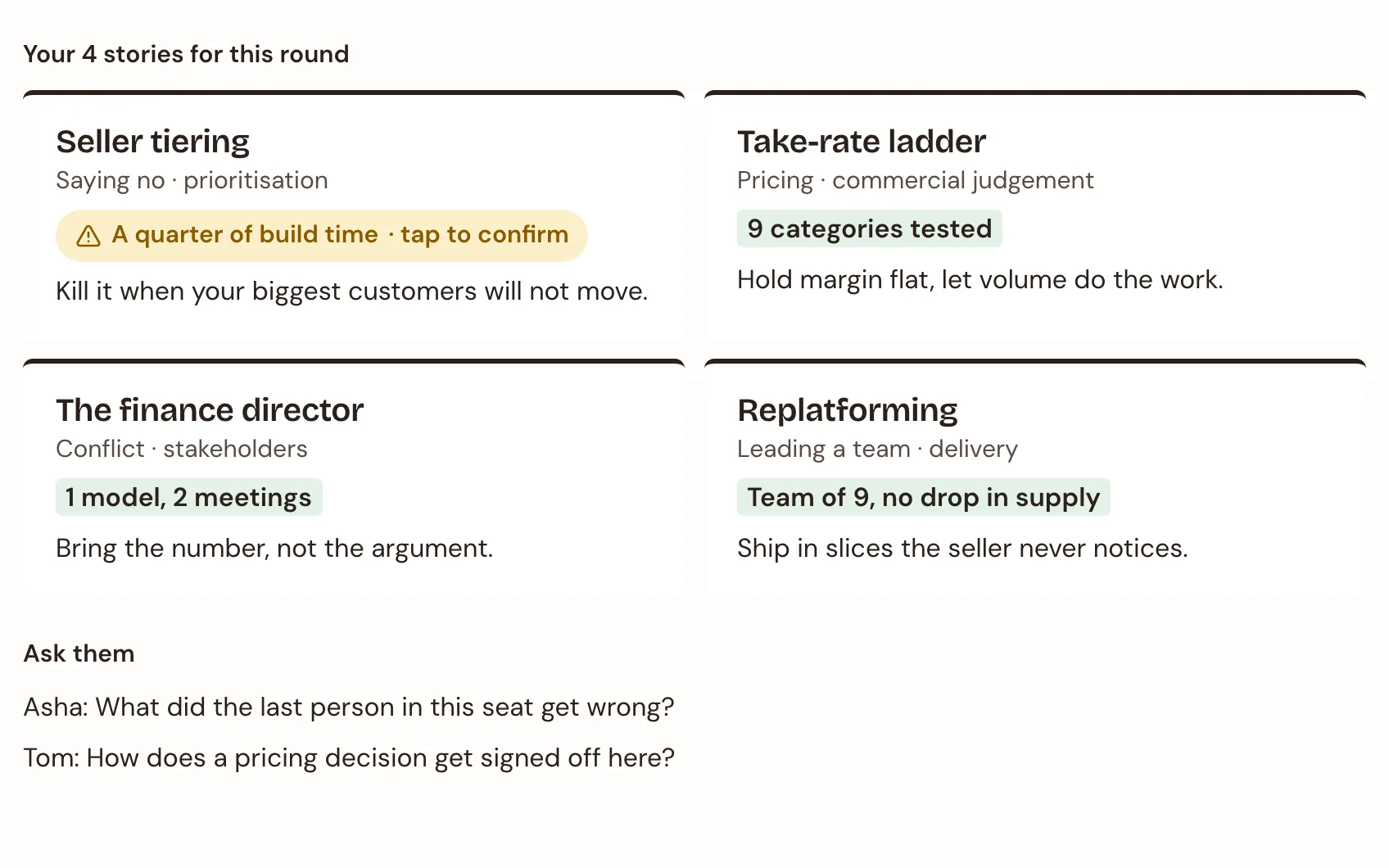
Four stories on the card, each with what it answers, one number and one rule.

A story on the card, with its rule. Example application. Company and people invented.

One page per interview.

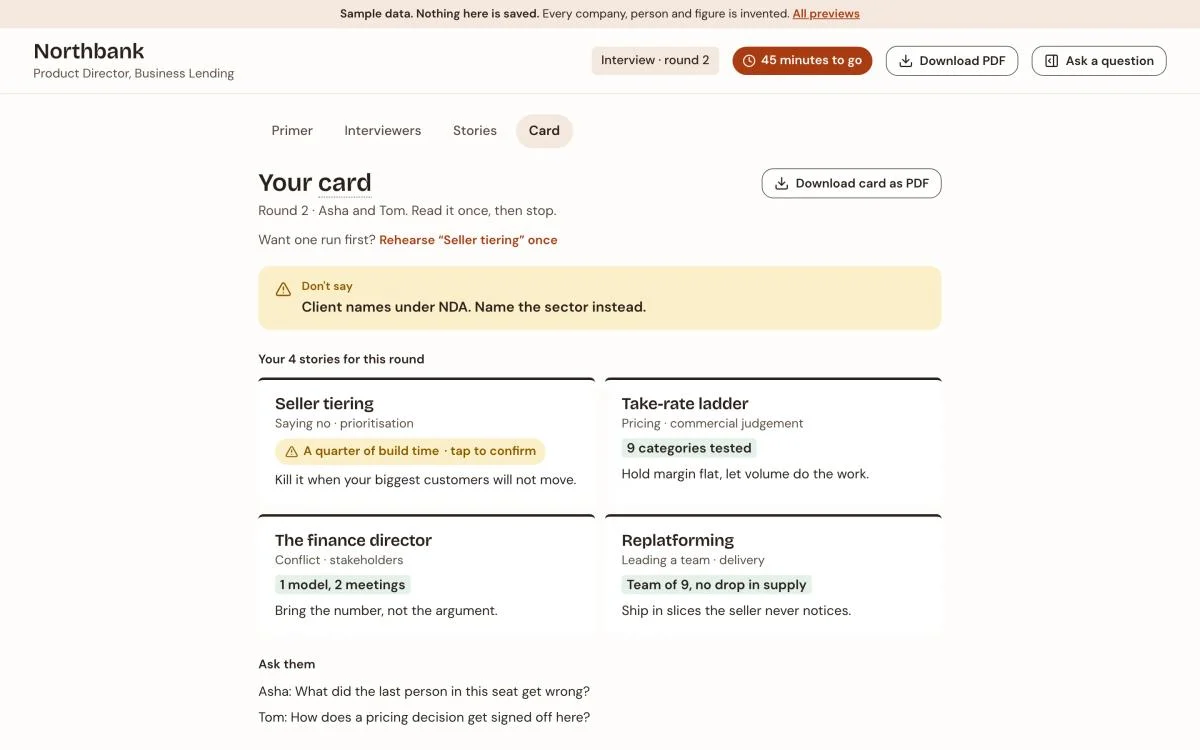
Your core stories, the questions each one answers, one number and one rule for each, the questions to ask each interviewer, and the things not to say. Print it, or open it on your phone before you walk in.

A short drill shows you a question and asks which story you’d tell.

A café table by a London window in morning light, with a coffee, a pen and a phone.
The one-page card 45 minutes before round 2: what not to say, four stories, and the questions to ask each interviewer.

The card. Example application. Company and people invented.
Only what you’ve confirmed.

When a general AI assistant wrote an answer pack for one interview, 124 of its 315 claims about the candidate didn’t match their record.

Some were embellished; some contradicted it.

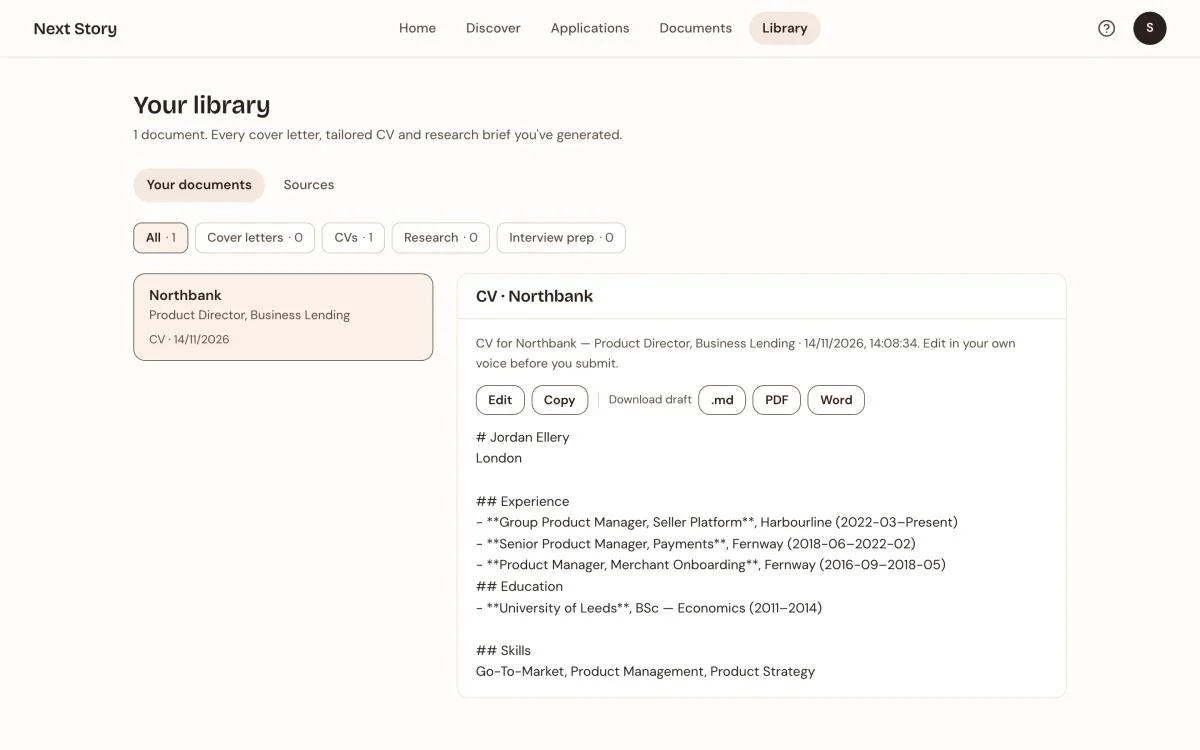
Next Story tailors your CV and cover letter for each role from facts you’ve confirmed and nothing else. You never get a CV that claims something you’d have to walk back in the room.

A tailored CV for the Northbank role in the library, with buttons to download it as Markdown, PDF or Word.

A tailored CV, ready to download. Example application. Company and people invented.
Tell it how it went.

Afterwards, Next Story asks how it went. Paste your notes and it pulls out the questions you were asked, notices where what you said drifted from your record, and updates your stories and the card for the next round.

What it doesn’t do.

It doesn't help during the interview.

Nothing listens in or prompts you on the call. You walk in prepared.

It doesn't find jobs.

You bring the roles you want; it does the work on each one.

It never applies for you.

You send everything yourself.

Walk into every interview prepared.

Starter and Pro prepare you for every role you’re interviewing for, from first round to offer. Free builds your record and gets you started with a few tailored CVs.

Free

£0


Starter

£49

a month

Pro

£99

a month

Interview prep

Everything for one role, from first round to offer: research on the company, a view of each interviewer, and 4 to 6 core stories for each round, each with one number and one rule. Likely questions come from the employer’s own brief, your earlier debriefs, each interviewer’s role and published writing, and the advert. You also get a one-page card, a pick-the-story drill and a debrief after each round.

Free
Not included
Starter
Every role you add
Pro
Every role you add

Your experience interview

A conversation about your work that builds your record. It reads your CV, personal site and GitHub, asks where they disagree (a different headline on your CV and your LinkedIn, say) and fills what’s missing, in 30 questions at most. Later, whenever an advert or a story needs something it doesn’t know about you, it asks one specific question. Nothing is used until you’ve confirmed the exact wording.

Free
Included
Starter
Included
Pro
Included

Tailored CVs

A new CV and cover letter for each role, from your confirmed facts only. The advert decides what leads and what’s left out: which roles, results and skills go first. It never decides what’s claimed. You see which of the advert’s key terms your CV covers, and where the advert asks for something your record doesn’t show, so you can answer a question to fill the gap or leave it out.

Free
3 a month
Starter
7 a month
Pro
15 a month

Interview prep covers company research, a view of each interviewer, story sessions, the one-page card and a debrief after each round. The plans differ only in how many tailored CVs you can make each month.

Start free

Questions.

Who is it for?

Mid to senior people in product, engineering and go-to-market roles applying to UK tech companies.

Does it write things about me that aren't true?

Your CV and letters use only facts you've confirmed. In practice drafts, anything unconfirmed is marked so you can confirm it or swap it.

Where is my data kept?

In London. Our privacy notice and list of subprocessors say who processes what.

What counts towards my plan?

Each tailored CV you generate counts towards your month. Adding roles and checking fit don't.

Walk in knowing what you’ll say.

Start free

Free covers your experience interview and 3 tailored CVs a month.

A candidate in a camel coat walking into a bright office lobby in the morning.